How to Choose a Sportswear Manufacturer: 15 Questions to Ask Before You Pay a Deposit
Quick answer
Choosing a sportswear manufacturer comes down to what they say before you pay, not after. Ask fifteen questions in four groups — is it a real factory, how do samples and quality control work, what exactly do the MOQ, price and payment terms mean, and how do production and delivery actually run — and judge the answers for specificity. A real manufacturer answers with numbers, timelines and process. A risky one answers with adjectives. Below are the fifteen questions, what a good answer sounds like, and the red flags that should stop a deposit.
Why the questions come before the deposit
A deposit changes the relationship. Before it, you are a customer being courted and every question gets answered. After it, you are a production slot, and the answers you never got become the arguments you cannot win. None of the fifteen questions below is hostile — every legitimate factory answers them routinely, because they are the same questions its long-term buyers asked on their first orders. What you are testing is not just the answers but the manner of them: precise and written, or vague and verbal. Get the important ones confirmed in writing with your quote, so the agreement exists somewhere other than in a chat thread.
Group 1: Is it a real factory? (Questions 1–3)
1. Are you a factory, or a trading company? There is no wrong answer — there is a dishonest one. A good trading company can be a fine supplier. The problem is a trader claiming to be a factory, because then the “factory’s” answers about production control, timelines and quality are fiction. An honest supplier tells you plainly which it is and who actually makes your garments.
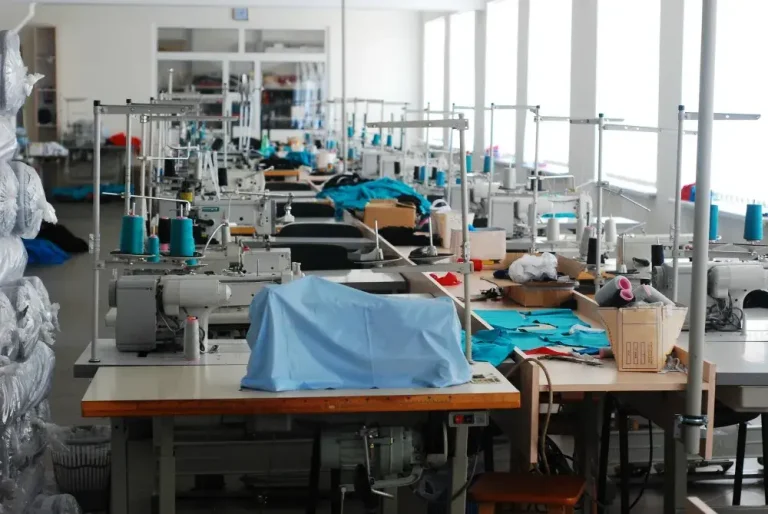
2. Can you show me current production — not a brochure? Ask for recent photos or a walk-through of the floor with work in progress. Real production looks like production: cut panels, part-finished garments, your kind of products on the line. A red flag is a gallery of polished stock-style photos and nothing current. A factory that is sewing today can show you sewing today.
3. What do you make in-house, and what do you send out? Printing, embroidery and stitching under one roof means the supplier controls quality and timelines directly. Outsourced stages are normal in this industry, but they add hand-offs — and hand-offs are where delays and mismatches happen. The answer you want names which stages are in-house and which are not, without hesitation.
Group 2: Samples and quality (Questions 4–7)
4. What is your sample process — and is a sample free? The non-negotiable structure is a pre-production sample: one real garment, made the way bulk will be made, approved by you before production starts. At Alisterz a free sample is available and the sample takes 5–7 days; whatever factory you choose, the sample stage must exist and the timeline must be stated. “We don’t do samples on bulk orders” ends the conversation.
5. What exactly will the sample be made from? The sample only proves something if it uses the real fabric, the real decoration method and your real artwork. A sample in a substitute fabric proves the substitute fabric. Confirm in writing: same fabric, same construction, same logo method as bulk.
6. How is quality checked during and after production? You are listening for a process, not a promise: checks while the run is being made, a final inspection and count against your size and quantity list before packing. If the entire answer is “quality is very good, don’t worry,” worry.
7. If bulk doesn’t match the approved sample, what happens? This is the most important question on the list, so ask it before there is anything to argue about. The approved sample is the standard bulk is judged against — a serious factory will say so and tell you how a mismatch is put right. Get that answer in writing with the quote. A supplier who will not commit to its own sample will not commit to you later either.
Group 3: Money — MOQ, pricing and payment (Questions 8–11)
8. Is your MOQ per style, per colour, or per order? Three different numbers wear the same label. Many of our styles start from 100 pieces per style and some at 500, stated per style in the quote — that is the level of precision to expect from anyone. Our full guide to what MOQ means explains the distinctions; use it to interrogate any quote that just says “MOQ 100.”
9. Is pricing tiered — and what is actually included in the unit price? Tiered pricing (unit price falling as quantity rises) is how real production costs behave, so a single flat price at every quantity deserves a question. Then pin down inclusions: fabric, decoration, labels, hang tags, packaging — and what is not included, especially freight. Two quotes are only comparable when both itemise the same things.
10. What are the payment terms, and what does each payment trigger? Terms vary, and there is no single correct split — but the structure must be written into the quote before you commit, with each payment tied to a stage you can verify (order confirmation, sample approval, dispatch). The pattern to refuse is full payment up front to a supplier you have never ordered from, against nothing but promises.
11. Who pays when something goes wrong? Mistakes come in two kinds: the factory made it wrong against your approved spec, or you changed the spec. A fair supplier owns the first and prices the second. If a supplier will not discuss factory errors at all before the order, you have learned what the discussion will look like after it.
Group 4: Production and delivery (Questions 12–15)
12. When does the production clock start? At Alisterz, bulk production is 15–20 days and the clock starts at sample approval — not at your first email, not at the deposit alone. Many “late order” stories are really this misunderstanding: the buyer counted from the enquiry, the factory counted from approval. Ask, and plan from the real start line. Our step-by-step ordering guide shows where each stage sits.
13. What is not included in that timeline? Your own approval time, artwork fixes and shipping all sit outside the production days. An honest timeline names them separately: sample 5–7 days, your approval (up to you), production 15–20 days, then delivery. A quote that promises one total number for everything is rounding in the supplier’s favour.
14. How do you ship, and can I choose? Worldwide shipping by DHL/FedEx air or sea freight is the standard offer — air lands in roughly 4–7 days to most destinations; sea takes several weeks and suits large, planned orders. What matters is that the choice, and its cost, is quoted openly rather than decided for you.
15. How will I hear from you while my order is in production? You should expect updates at the natural points — sample ready, production under way, dispatch with tracking — without having to chase. Test this during the quote stage: a supplier who is slow and vague when they are trying to win the order will not become fast and precise after your deposit.
Red flags, in one place
| Red flag | What it usually means |
|---|---|
| Won’t say whether it’s a factory or a trader | You will never know who makes your order |
| No pre-production sample, or sample in substitute fabric | Bulk quality is a gamble, by design |
| MOQ quoted with no per-style/per-colour breakdown | The real minimum appears later, higher |
| One flat unit price at every quantity | Not pricing from real production costs |
| Full payment demanded up front, terms not in writing | You carry all the risk; they carry none |
| “Production time” counted from your first email | A deadline argument is already scheduled |
| Goes quiet when asked about errors and remedies | That silence is the answer |
How Alisterz answers these questions
Plainly, since this is our list: we manufacture in Sialkot, Pakistan, and sell factory-direct to wholesale buyers. MOQs are per style — many styles from 100 pieces, some from 500 — and confirmed in the quote. A free sample is available; pre-production samples take 5–7 days and are made with the real fabric and your real decoration, and bulk is judged against the sample you approved. Pricing is tiered, with the unit price at your quantity and the next tier shown. Bulk production is 15–20 days from sample approval, shipping is worldwide by DHL, FedEx or sea, and payment terms are confirmed in writing with the quote before you commit. If you are building a label rather than kitting out a team, the same questions apply — our private label activewear manufacturer post shows how the answers look for brand orders.
Frequently asked questions
Should I always choose a factory over a trading company? Not automatically. Choose honesty and control over labels: a trader who tells you who makes the garments, and can still guarantee the sample-and-approval process, is a safer supplier than a “factory” that cannot prove it sews anything. The first three questions exist to establish which one you are actually dealing with.
How many manufacturers should I get quotes from? Two or three, quoted on the identical spec — same garment, same fabric, same decoration, same quantities. Quotes are only comparable when the spec is identical; a cheaper quote on a lighter fabric is not a cheaper quote, it is a different product. Send every candidate the same brief and compare the breakdowns, not just the totals.
Is a free sample a sign of a good manufacturer? It is a sign of confidence, not proof of quality — the proof is the sample itself, checked properly: fabric in hand, seams pulled, logo inspected, one wash done. At Alisterz a free sample is available on first orders precisely because we would rather be judged on a garment than on a web page.
What is the single most important question on the list? Question 7 — what happens if bulk doesn’t match the approved sample. It tests whether the sample is a real standard or a sales tool, and whether the factory will commit in writing before money moves. Every other failure is recoverable; a factory that won’t stand behind its own sample is not.
Can I start small with a new manufacturer? Within the MOQ, yes — and a first order at a sensible quantity is a reasonable way to test any supplier, including us. Many styles start from 100 pieces, which is a genuine production run, not a token. Prove the relationship on one style, then expand; that is how most of our repeat buyers started.
How long should choosing a manufacturer take? Days of questions, plus the sample stage — and the sample stage is part of choosing, not a delay after it. Rushing the choice to save a week, then losing a season to the wrong factory, is the arithmetic this whole list exists to prevent. If you are still at the idea stage, our guide on how to start a sportswear brand sequences the decisions before manufacturer selection.
Put us through the fifteen questions
Send your style, quantities and deadline through the Request a Quote page and hold the reply up against this list — the MOQ, the tiers, the sample timeline and the terms should all be there in writing. Browse the shop to see the ranges we manufacture, from soccer uniforms to hoodies, and if any of the fifteen answers is missing from our quote, ask us — that is what the questions are for.