Bavarian Outfits Wholesale — Lederhosen, Dirndls and Trachten Wear in Bulk
Quick answer
Alisterz manufactures Bavarian outfits in bulk from Sialkot, Pakistan, for retailers, breweries, German restaurants and festival suppliers: lederhosen with suspenders, dirndls with blouse and apron, Trachten shirts, waistcoats and the hats and accessories that complete the outfit. Trachten wear is judged on details — real embroidery, proper dirndl construction, lederhosen that look like leather work and not costume plastic — so every style is confirmed on a physical sample before bulk production. The sample takes 5–7 days with a free sample available, bulk production runs 15–20 days, and we ship worldwide by DHL, FedEx or sea. Pricing is tiered, the per-piece cost falls as quantity rises, and the MOQ is confirmed for your exact styles in the quote.
The spec summary
| Product families | Lederhosen, dirndls, Trachten shirts, waistcoats, Bavarian hats and accessories |
| Lederhosen lengths | Short (kurze) and knee-length (Bundhosen style) |
| Lederhosen materials | Genuine leather and leather-look options — your choice per price point |
| Dirndl construction | Bodice dress, separate blouse, apron — three real pieces, tied at the front |
| Details | Embroidery on lederhosen and bodices, horn-style buttons, checked and embroidered Trachten shirts |
| Branding options | Custom logos, your labels and packaging for resale orders |
| Sample | 5–7 days; free sample available |
| Bulk production | 15–20 days after sample approval |
| MOQ | Per style — confirmed in your quote |
| Pricing | Tiered: unit price falls as quantity rises |
| Shipping | Worldwide — DHL/FedEx air or sea freight |
The three products that make up a Bavarian range
“Bavarian outfit” is not one product — it is a men’s line, a women’s line and a shirt line that sit next to each other on the same rail. Buyers who stock all three sell complete outfits; buyers who stock one sell a piece and watch the customer buy the rest elsewhere.
| Product | What it consists of | Who wears / buys it | Construction points that matter |
|---|---|---|---|
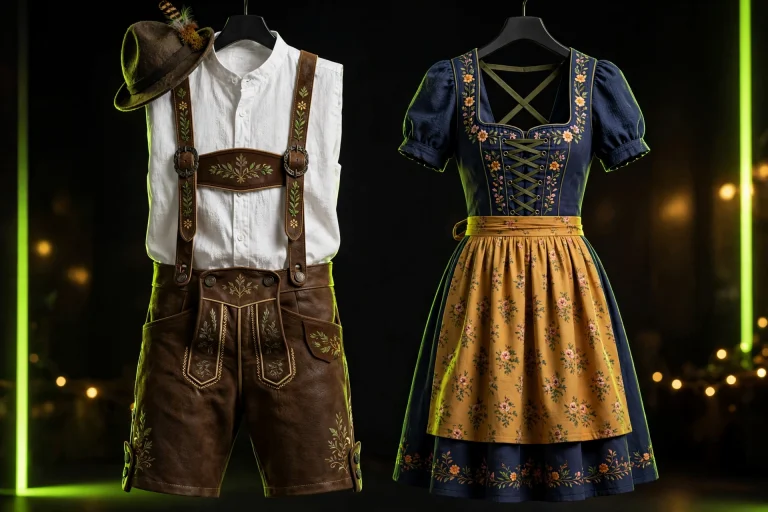
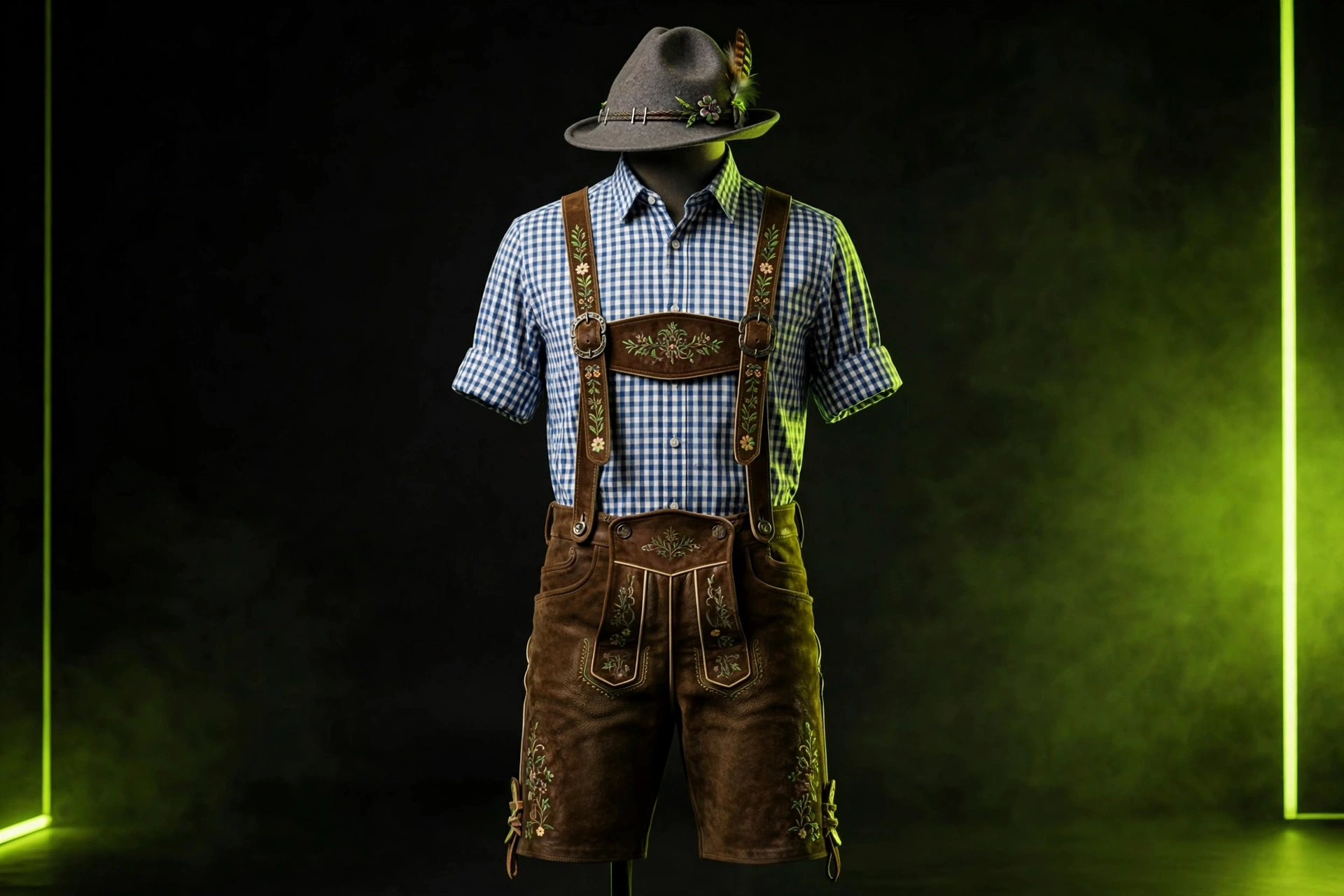
| Lederhosen | Leather (or leather-look) breeches, usually worn with suspenders featuring a chest strap | Men — festival wear, brewery and restaurant staff, folk groups | Embroidery on the legs and bib, drop front styling, reinforced stitching, horn-style buttons |
| Dirndl | Fitted bodice dress worn with a separate blouse underneath and an apron tied at the front | Women — festivals, hospitality staff uniforms, retail ranges | Bodice fit and lacing or zip, blouse included or separate, apron length matched to dress length |
| Trachten shirt | Traditional shirt, typically checked or white with embroidered details, horn-style buttons | Men and boys — pairs with lederhosen or worn alone | Collar style, embroidery placement, fabric weight for a full day of wear |
Beyond the three core pieces, waistcoats (often in loden-style cloth), felt hats and checked scarves round out a retail range — order them in the same colour story as your shirts and dirndls and the whole rail works together.
Lederhosen: leather, lengths and the embroidery question
Lederhosen traditionally are leather breeches, and the leather choice sets your price point. Genuine leather — traditionally deer, goat or cow hides — is heavier, develops character with wear, and is what premium Trachten retailers sell. Leather-look and lighter materials serve the festival and event market, where the outfit may be worn a handful of times a season and the buyer is a brewery outfitting a whole staff, not a customer buying a lifetime garment. Be honest with yourself about which customer you serve, because the two products are built and priced differently, and the sample is where you feel the difference in hand.
Length is the second decision: short lederhosen are the classic festival style, knee-length Bundhosen the more traditional and formal cut. Most ranges carry both. Suspenders are not an accessory to forget — the embroidered chest strap is one of the most visible parts of the outfit, and lederhosen are normally sold and worn with them, so order them as sets unless your customers already own suspenders.
Embroidery is where cheap lederhosen give themselves away. The traditional motifs stitched along the leg seams, bib and pocket areas should be dense, even embroidery — printed-on “embroidery” is visible at arm’s length. If you are comparing our quote with another, compare the embroidery on the samples, not the photographs.
Dirndls: a three-piece garment, and the apron is not optional
A dirndl is built in three pieces: the fitted bodice dress, the blouse worn underneath, and the apron tied at the front. Ranges that skip the apron or sew a fake apron panel onto the skirt are cutting the corner customers notice first — the tied apron, with its bow, is part of the silhouette. Traditional detail worth knowing for your product descriptions: the position of the apron bow is an old folk signal — tied on the wearer’s left traditionally means unmarried, on the right married, at the back widowed or serving staff. Your customers at folk festivals know this; it is a detail your range should respect rather than “fix”.
Length and fabric set the register: longer dirndls in muted colours for traditional and hospitality wear, shorter and brighter for festival ranges. Bodice lacing versus a concealed zip is a construction choice — lacing reads more traditional, a zip is faster to wear and simpler for staff uniforms. Tell us which your buyers expect and the sample is built that way.
Who buys Bavarian outfits in bulk
Trachten and folk-costume retailers buy full ranges across both genders — lederhosen, dirndls, shirts and waistcoats in coordinated colours — and reorder proven styles season after season.
Breweries and German restaurants buy staff outfits: durable dirndls and lederhosen with Trachten shirts, often with a custom logo worked into the shirt or apron, sized across a full staff roster. For staff wear, wash durability and a full size run matter more than ceremonial detail.
Festival and event suppliers buy festival-grade outfits in volume ahead of the season — their buying calendar is the subject of our Oktoberfest outfits guide, because event demand runs on fixed dates and freight waits for nobody.
Folk dance and heritage groups buy matching sets where every piece has to agree in colour and embroidery across the whole group — the same consistency discipline as a band or team order.
Sizing and matching across the range
Dirndls are bought in standard dress sizes and the bodice fit is the garment — too loose and the silhouette is gone. Lederhosen are waist-sized in inches, like other traditional trousers, and leather styles are expected to fit snugly at first. Weight both size runs to your market’s real demand, keep the middle sizes deep, and confirm the runs in writing before cutting. For sets sold as outfits, order shirts and waistcoats against the same size distribution as the lederhosen, or your largest customers will find half an outfit waiting for them.
MOQ, samples, production and shipping — the honest terms
- Minimum order: set per style and confirmed in your quote — traditional wear minimums are style-dependent, so the quote carries the exact figure for the pieces you choose.
- Sample: pre-production sample in 5–7 days in the real material and construction. A free sample is available — on Bavarian wear, use it to judge the embroidery density, the dirndl bodice fit and the lederhosen finish in hand.
- Bulk production: 15–20 days from sample approval.
- Shipping: DHL/FedEx air (roughly 4–7 days to most destinations) or sea freight for large, planned seasonal orders.
- Your branding: custom logos, labels and packaging applied during production, so resale stock arrives shelf-ready.
Frequently asked questions
What is the minimum order for Bavarian outfits? It is set per style and confirmed in the quote. Send the styles and size runs you are planning and we will confirm the exact minimum and tier price for each — lederhosen, dirndls and shirts are quoted as separate styles.
Are your lederhosen genuine leather? Both routes are available: genuine leather for premium Trachten ranges, and leather-look materials for festival and staff-uniform price points. The quote and the sample state the material plainly, so you approve exactly what will be produced.
Is the dirndl a complete three-piece outfit? Yes — bodice dress, blouse and apron as real separate pieces, the way a dirndl is worn. Apron and blouse can be quoted as part of the set or as separate stock, depending on how you retail them.
Can brewery or restaurant logos be added to staff outfits? Yes. Custom logos can be embroidered or printed on Trachten shirts and worked into aprons and waistcoats, and your own labels and packaging are applied during production. Send the logo artwork with your enquiry so the sample carries it.
How long does a bulk Bavarian order take? Plan on 5–7 days for the sample, 15–20 days for bulk production after approval, plus shipping — roughly 4–7 days by air or several weeks by sea. If the order is aimed at a festival date, read our Oktoberfest planning guide and work backwards from the event, not forwards from today.
Can I reorder the same styles next season? Yes. Once your sample is approved, your patterns, embroidery files and size grading stay on file, so next season’s reorder matches this season’s stock — and skips the sampling stage if nothing changes.
Get your Bavarian outfits quoted
Send the styles you are planning — lederhosen lengths and materials, dirndl lengths, shirt styles — with your size runs and quantities through the Request a Quote page and we will come back with per-style minimums, tiered pricing and a sample timeline. You can see the wider traditional-wear range we produce in the shop — and if Bavarian wear is part of a bigger seasonal order, say so in the same message and we will quote it all together.